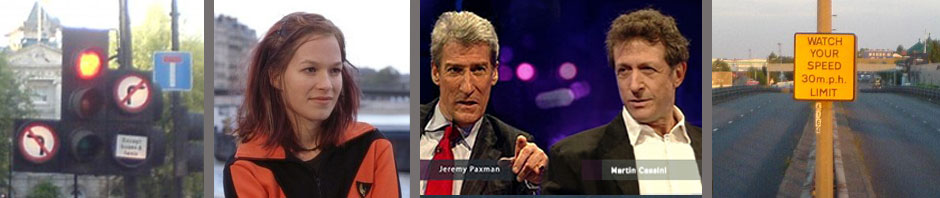
The fundamental principle of road safety is to watch the road. What do traffic lights and instructional road signs do? Take our eyes off the road.
As currently misconceived, traffic control interferes with the primary task of watching the road and acting according to context. It seeks to turn us from social animals into robots fit only for obeying rules.
Professor Frank McKenna told me that “road-users must learn to conform to a system”. Wouldn’t it be better to devise a system that conforms to human nature? Accidents are routinely blamed on driver error. But the role of traffic control in thwarting our social instincts and causing “accidents” has never been studied (who will back a study?).
Most “accidents” are not accidents; they are events contrived by the misguided rules and design of the road.
What do you do if you’re approaching a green light at a legal 30 – or even 20mph – when a child appears in your path, but an unsighted ten-ton truck is on your tail? Such intolerable conflicts are manufactured every day by the anti-social rules of the road. “For threatening my baby, unborn and unnamed, you ain’t worth the blood that runs in your veins!” sings Bob Dylan in Masters of War. The charge could be levelled at policymakers in the traffic arena.
Priority is the cause, the whole cause and nothing but the underlying cause of most of our problems on the road. The solution is education not regulation, reform not enforcement.
Priority imposes unequal rights and responsibilities. It puts us at odds with each other and our surroundings. It makes us compete for gaps and green time. It demands our attention, denies choice, outlaws discretion, prevents infinite filtering opportunities and expressions of fellow feeling.
Accident statistics are spurious because they are compiled in the context of priority. An infinitely safer basis for road-user interaction is equality.
Traffic lights encourage inappropriate, conflicting speeds, as some drivers rush to beat the green while others slow down anticipating a return to red. With self-control, approach speeds are low. My interest in avoiding collision with you mirrors your interest in avoiding collision with me.
So which is safer – automated control based on priority, or self-control based on equality?
The following quote is from a Brake! press release of 14 March 2014: Road crashes are not accidents; the use of the term ‘accident’ undermines work to reduce road risk and causes insult to families whose lives have been torn apart by drivers taking risks on roads.
Of course I share the sentiment and the anger, but Brake! misses the point. We’re all victims of a dysfunctional system. Until the underlying cause of danger is addressed – the lethal, unequal priority rule – everything else is pointless window-dressing.
The point is to change the rules of the road: from priority, which encourages intimidation and neglect, to equality, which allows us to rediscover our manners and our humanity.
