Speed

Does speed kill? No, speed is neutral, like fire. It’s speed in the wrong hands, or inappropriate speed that kills – the very speed we get at priority and signal-controlled junctions. Instead of driving by rote and numbers, we should drive according to context.

BRAKE! would claim that freedom to exercise judgement based on context is a licence to drive carelessly. On the contrary, it’s a blueprint for driving with true care and attention.

If pedestrians, especially children are near, let us proceed at walking pace. As a reasonable trade-off, when the road is clear, let us, within reason, drive at our own chosen speed.

On busy or narrow streets, 30 or even 20mph is too fast, yet speed limits license speed at the posted limit, absolving drivers of responsibility in the event of an “accident”. Would you want to be hit by a bus doing 20mph? Six year-old Ben Alston was.

All too often, speed limits are irrelevant to the needs of the moment. It’s ludicrous to operate traffic lights all night, and ludicrous to operate speed cameras all night.

Full-time carer, Alec Dennis, 61, pleaded guilty to driving at 52mph in a 30 limit on his way to hospital, where he was taking his son who had stomach pains. Dennis was worried about leaving his disabled wife, but feared his son had appendicitis (it turned out to be kidney stones). He didn’t call an ambulance because of delays experienced in the past. Dennis got 6 points, an £85 fine and a £15 victim surcharge. The time of day the speed camera caught him committing his “crime”? 4.20 a.m. On the face of it, his conviction sounds criminally inappropriate. Story here.

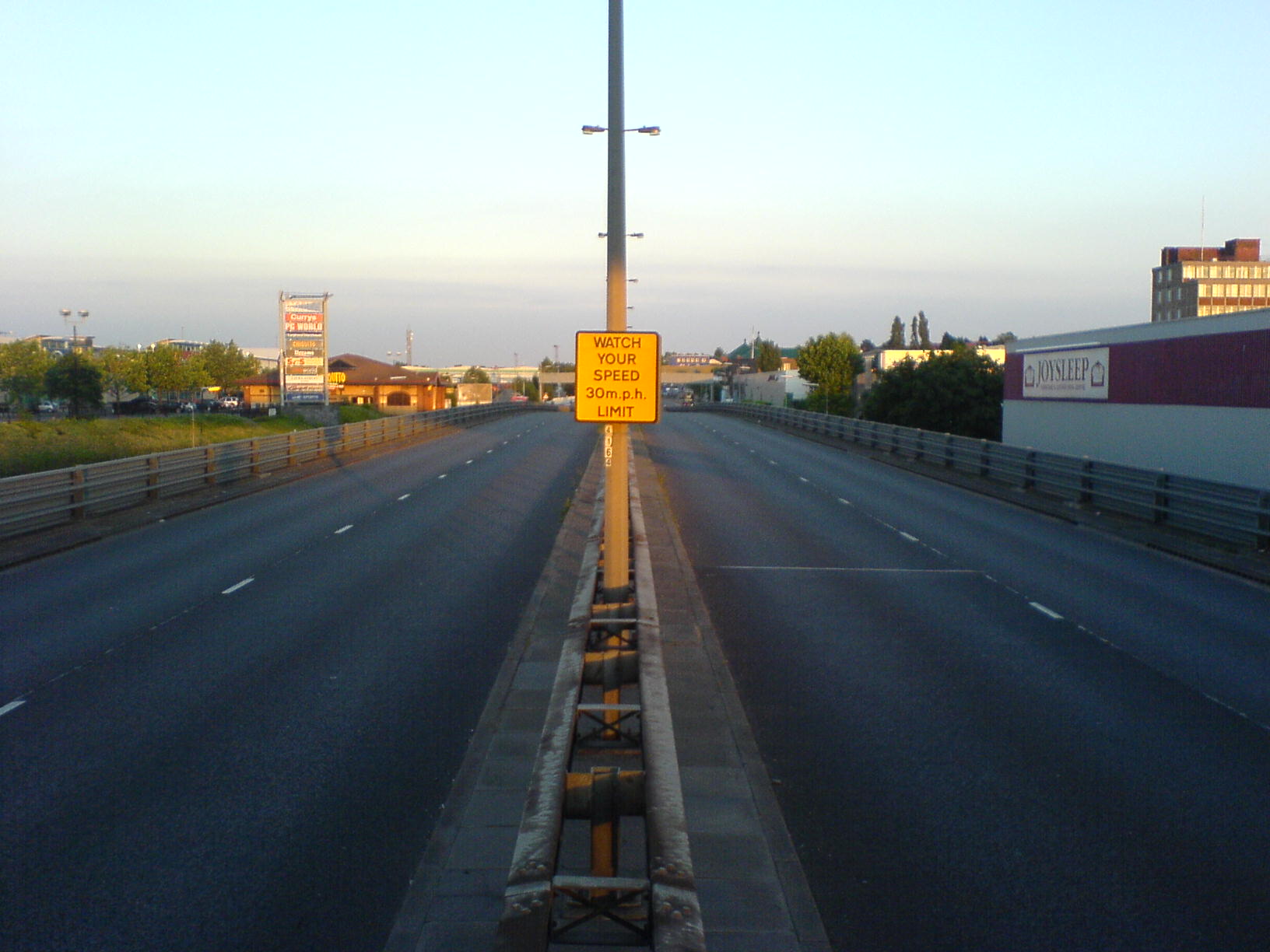
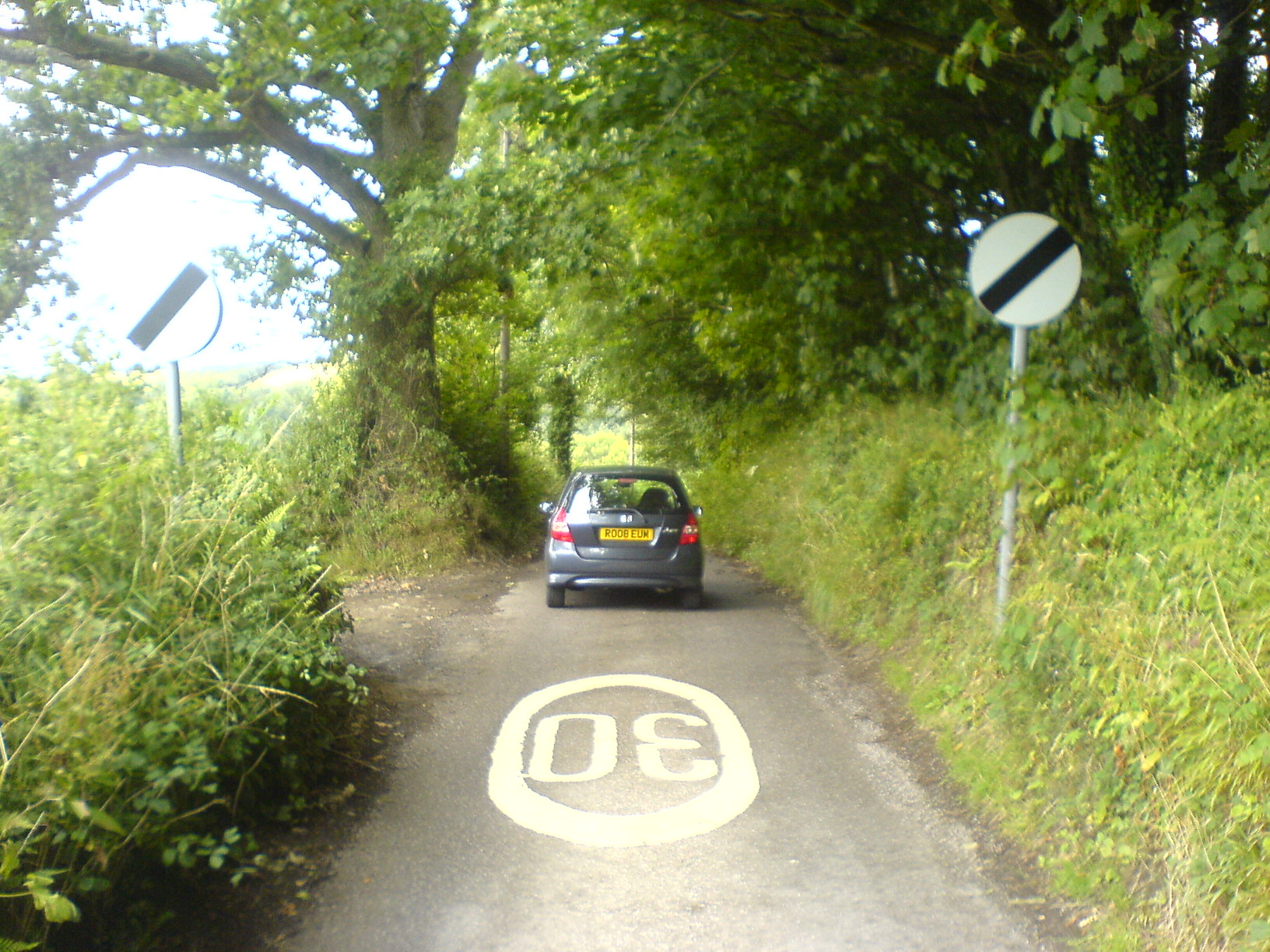
No-one minds reasonable regulation. What makes us see red is regulation for its own sake, or regulation geared to raising revenue. As the photo shows, limits can be nonsensical. Where is the spirit in all this regulation? Conspicuous by its absence.
Instead of watching the speedometer and watching out for cameras, we’ll watch the road, surely the safest of safety principles. An advanced driving test should be phased in, to include hours of computer simulation, skid-pan experience, and practice based on a full appreciation of all the elements involved.
No limits on motorways would bring at least one big advantage: lane courtesy and an end to middle lane-blocking, which would free up at least a third of motorway capacity.

Life is about infinite variables, so one-size-fits-all rules are a contradiction in terms. Far better to rewrite the rules, and let people act according to the needs of the moment.

Whether or not Chris Huhne tried to pass the buck, his saga reveals the contortions to which citizens can be driven to escape the tentacles of a system that values the letter of the law above the spirit.

For all the negative publicity about “speeding” (a fabricated crime), you’d think exceeding the limit was a major factor in “accidents”, yet the DfT blames it for only 5% of accidents. See P.7 of this document, under the heading “Injudicious actions”.

“The safest drivers are those who drive faster than average,” writes Chad Dornsife of the US Best Highway Safety Practices Institute, “yet they are the primary targets of speed enforcement. The desired safety effect of speed limits is achieved by removing them.”

While Swindon has decommissioned its speed cameras, Oxfordshire has reactivated theirs. There’s a lively discussion about it here.

Electronics engineer, Dave Finney, questions official policy on speed here and here.

16 Responses to Speed

  1. Noel Staples says:

    Two speed limits on the same road . . .
    I’m an HGV driver, thus subject to a 40mph speed limit on all rural single carriageway roads when driving artics or any HGV. Yet car drivers are subject to a 60mph speed limit on deristricted single carriage roads. So from my vantage point high above the road I often watch cars carry out very risky overtaking. Occasionally I have even been overtaken by other HGVs! Police seldom enforce the 40mph HGV speed limit, unless they are observing an otherwise risky driving behaviour. Yet some speed cameras are set to trap HGVs exceeding 40mph as well as cars doing over their 60mph speed limit. I know to my cost, which is why I now mostly stick to 40mph, though I hate seeing the long tail behind me. The busy A47 from Leicester to Peterborough is almost all single carriageway, as it is for considerable stretches all the way to Yarmouth.
    In 1999 I was driving an empty 44 tonne cement tanker south along the A11 through Thetford Forest when a car full of small children attempted to turn right out of the B1112 Icklingham Rd right in front of me when there was insufficient gap in the long line of northbound traffic. There was nowhere I could go and I began braking as hard as I dared, expecting to see my tank start to swing out any moment and start to jack-knife. BUT, this rig was equipped with disk brakes throughout, AND ABS, a requirement on all HGVs built since 1992. No wheels locked up, no skidding, and I braked safely to a halt amidst much rattling and shuddering in a dead straight line, stopping inches from the car full of small children. I suspect the very obviously frightened driver of the car needed a change of underwear!
    The point of the anecdote is that HGVs are now very much safer, with much better brakes and brake operating systems than when I began driving HGVs in the early 70s. The 40mph limit on single carriageway roads is a dangerous anachronism, frustrating both for truck drivers and car drivers alike. It would be far better to raise the HGV limit to 50mph on single carriageways, a speed which would be rather less likely to encourage risky overtaking!
    For those who wonder why TESCO drivers stick to the 40mph limit, the reason is that management monitor the sat tracking records to check vehicle speed on single carriageway roads. Drivers found to be exceeding the single carriageway limit may be disciplined. Other major hauliers may do the same because fuel consumption is considerably improved at 40mph, though journey times are increased.

  2. Martin Cassini says:

    Telling points. On the fuel point, though, surely you compensate for the higher speed by being in a higher gear, thus keeping revs and fuel use the same?

  3. Westkentview says:

    I know about shared space in Denmark and elsewhere, and am attracted to the idea. The weakness in your argument, however, is the unfailing trust you put in human nature. As well as driving, I cycle frequently and know from experience that most drivers are actually rather considerate. Which however leaves the minority… who are the ones who take the risks and, logically, cause the accidents. That is precisely why rules are needed, as these individuals simply cannot be trusted to behave themselves and will inevitably see the absence of lights etc as – figuratively speaking – a green light to drive how they want. So to return to shared space: I am all for it, but only in clearly designated places, not as a general rule.

    • Martin Cassini says:

      Far from being a weakness, my trust in human nature to do the right thing (given a choice) is the strength of my argument. Human nature is our greatest resource. Traffic policy ignores it to our general detriment. You can’t even legislate for “maniacs”, so it’s absurd to construct a system with them alone in mind. Social etiquette is a greater force than vexatious regulation. Even your hypothetical deviant will fall into line when given responsibility and choice. The role of vexatious regulation in messing with our minds and provoking anti-social behaviour has never been studied, but my hunch is that it is behind most incidents of road rage.

  4. RichardX says:

    What are people’s views on the increasing introduction of 20mph? Whilst I consider it may have value at certain times in the vicinity of schools and day nurseries, its wider use is a step too far. In my home town of Middlesbrough we have had 20mph zones near certain schools for some time. However, the Council are about to impose such limits over most of the town centre area, together with many suburban areas, save for ‘through routes’ and arterial roads. While some such zones are ‘part-time’, controlled by lights indicating when the limit applies, in most cases the limit operates all day which is ridiculous. In my opinion they will do little to improve road safety. They will just aggravate drivers, increase fuel consumption, pollution and congestion. There will be no impact on boy racers who have no ragard for the safety of other road users. Personally, I will continue to drive safely and responsibly as I have done since 1964, but that doesn’t mean I’ll be crawling along at 20mph late at night or when such roads are deserted. I’ll drive according to the prevailing conditions and not be governed by arbitrary, unrealistic speed limits. Modern cars are not designed to chug along at 20mph for lengthy periods. I just hope that commonsense will prevail regarding the enforcement of 20mph but it’s probably too much to ask. I would object to being fined for doing 30mph in a 20 zone at midnight or when the roads were deserted. I know of a driver who was fined after been caught driving at 30mph in a 20mph zone at 2.00am. I have written to the Council expressing my opinions as contained in this post.

    • Martin Cassini says:

      Richard, I agree with everything you say except for the bit about modern cars not being designed for chugging along at 20. I’m happy to chug along at 1 or 2mph if the social context requires it, e.g. when children are around. As a perfect trade-off, we should be free to choose our own speed when no-one is around or on the open road.

  5. Bob Hinton says:

    The problem with proceeding at walking place whenever pedestrians are present is that it encourages them to behave in a totally dangerous fashion, smug in the knowledge that they can easily dodge a slow moving vehicle, thus you have to contend with pedestrians playing Russian roulette with their lives hoping cars will take desperate measures to avoid them.

    The whole thing about relating speed to the survivability of the person being hit is simply nonsense because they rely on a simple mass x velocity equation. For a start the mantra about if you are hit at 30 mph you stand a better chance of surviving is simply guesswork. In an accident it is impossible to accurately establish the speed of a vehicle at the time of impact, therefore a survivor might be hit and killed at 31 mph but it is also possible the vehicle was travelling at considerably less.

    There are many aspects to an accident which need to be taken into consideration – not just speed. In all my years driving I have struck two pedestrians, the first was a lady who tried to commit suicide by throwing herself under my car. Two things saved her, one I had seen the strange look in her eyes as she was standing at the kerb and all my instincts told me something was about to happen and I started to brake, I was travelling at about 10 mph when I struck her. Secondly I was driving a Rover P6 which has a relatively low bonnet, when I struck her she came up onto the bonnet and then fell off. Now if I had been driving slower there wouldn’t have been enough force to lift her and my vehicle would have simply knocked her down and I would have run over her, no doubt killing her.

    The second incident was almost the same but concerned a young teenager who ran along the pavement then without warning just launched himself into my path. I braked and swerved and was doing about 20 mph when he struck me. The impact however just shot him backwards like a snooker ball and dumped him on his backside. When the police asked why he did that he just replied he didn’t know!

    The point is if I had been travelling at walking pace in both those incidents I have no doubt there would have been fatalities.

    Remember Bridgett Driscoll (Google her) was killed by a car doing just 4 mph. In 1892 they did a survey of fatalities on London streets and they found the most lethal vehicle was a wagon called a van, which was also the slowest at 3mph. The reason for the lethality was that it knocked people down and then ran over them.

    • Martin Cassini says:

      Interesting, but if you are going at walking pace and watching what’s going on, you anticipate and slow or stop to let someone go who was there first. The last thing you’d do is hit them and keep going! This is from Wiki: Bridget Driscoll (died 17 August 1896, aged 44) was the first pedestrian victim of an automobile accident in the United Kingdom. As she and her teenage daughter May (and possibly one other person) crossed the grounds of the Crystal Palace in London, she was struck by an automobile belonging to the Anglo-French Motor Carriage Company that was being used to give demonstration rides. One witness described the car as travelling at “a reckless pace, in fact, like a fire engine”. Although the car’s maximum speed was 8mph, it had been limited to 4mph, the speed at which the driver, Arthur James Edsall of Upper Norwood, claimed to have been travelling. His passenger, Alice Standing of Forest Hill, alleged he modified the engine to allow the car to go faster, but another taxicab driver examined the car and said it was incapable of exceeding 4.5 miles per hour because of a low-speed engine belt.

  6. Bob Hinton says:

    But in practice that doesn’t work. The situation you describe works wonderfully if you are the only car driving along the street and you see a lone pedestrian waiting calmly on the pavement.

    But in reality you are in a queue of vehicles facing one way and you are facing a queue of vehicles waiting the other way. You will have pedestrians running at you from all angles including from behind stationary vehicles in the other lane. How do you sort out in a split second who, in your words, got there first? It’s impossible. And don’t forget the driver behind you is trying to sort out his mess as are the drivers in the other lane.

    Also as you’re trying to sort out all the pedestrians in order of arrival you stand a very good chance of running into the car in front as that is the one place you will not be looking.

    The starting point of any attempt to make our roads safer is to mandate that all road users – drivers, pedestrians, cyclists and so on, are responsible for their own safety and are required by law to use the roads in a safe and sensible manner. Now this, up to 50 years ago, used to be the norm, with pedestrians and cyclists being prosecuted along with drivers for behaving recklessly on the road. I was a magistrate for five years and I never had either a pedestrian or a cyclist brought before the bench although I could see them transgressing on a daily basis. The Daily Mail yesterday published some pictures of an MP riding his bike through two no entry signs and one red light. Will he be prosecuted? Don’t hold your breath, but a motorist doing the same thing would be in court so fast his feet wouldn’t touch.

    We must be one of the few countries in the Western world that do not have jaywalking laws – why not? They are there to stop pedestrians acting in a dangerous manner – surely that can only be a good thing?

    Just stop for one moment and think about a driver doing all the things that are presently done by cyclists and pedestrians. Driving on the pavement, driving through red lights, driving whilst talking on a phone, entering a carriageway without bothering to check the way is clear. Now do you think the police would turn a blind eye to that as they do to other road users? Until we get rid of this inequality and start treating everyone the same we are always going to have problems.

    • Martin Cassini says:

      We’re thinking along different lines. Nothing wrong with that – we’ll see if we can thrash things out and arrive at a compromise, or see if one can bring the other round to his way of thinking, or end up agreeing to differ.

      There is no danger in people on foot and people on wheels sharing the space equally, mingling and shuffling through. Chaotic it may be, but isn’t it a safer, more sociable scenario than cars driving through at speeds that could kill, creating a river of death, with people on foot going in fear of their lives, parents scolding toddlers for stepping on to the wrong grey surface, and having to wait until a red light produces a big enough gap in the traffic for them to cross? When I say filter in turn, I mean filter more or less in turn, reflecting how humans go about their lives when not regimented by a system of control that makes us act against their better nature and better judgement.

      To my mind, “jaywalking” is a fabricated crime, almost worse than “speeding”. Why should people on foot be prevented from crossing a road more or less when and where they choose? Given time of arrival as the optimum (social) basis for managing transit in public space, there will be time and space for everyone to reach their destination in due time, with minimum interference from outside management that cost lives, costs a fortune, and is demonstrably making a diabolical mess of things compared to what we can do using our highly-evolved innate ability to negotiate safe, efficient movement.

      You want to enforce traffic regulation against people on foot and cyclists. I want to release drivers from the strictures imposed on them by traffic regulation. Cyclists are pedestrians on wheels, as are motorists. None of us should be held in limbo by the tyranny of traffic lights. We should all be free to go on opportunity, on streets designed to express a social context, that allow common law principles of equal rights and responsibilities to flourish. Given Equality Streets, most of our MANufactured road safety and congestion problems would vanish in a puff of exhaust smoke.

  7. Bob Hinton says:

    Let me answer the points you have raised:
    There is no danger in people on foot and people on wheels sharing the space equally, mingling and shuffling through.Well let us have a look at the veracity or otherwise of that statement. We don’t have to rely on hypothesis we can actually go back to when people on foot and people on wheels did exactly that Victorian England. Unfortunately the facts paint an entirely different picture. In a report on traffic in London alone in 1899 the following casualty figures are: Killed 1460 and seriously injured 9,000 and that is just one year in one city!
    The fact is that foot and wheeled traffic cannot mingle safely because they are entirely different beasts. A car occupies a certain space but its route and speed can be fairly accurately calculated, it is either going forward or back it is going x mph. Therefore a car can be seen and avoided if necessary. However you can fit about 15 people in the space occupied by one car and each person can move in different directions and at varying speeds, it is therefore impossible to calculate a safe speed or route for a car which can deal with so many variables.
    scenario than cars driving through at speeds that could kill, creating a river of death, with people on foot going in fear of their lives, parents scolding toddlers for stepping on to the wrong grey surfaceAny speed can kill; the only way to avoid this is to have the vehicles stationary. Pedestrians do not go in fear of their lives provided they stick to their appointed routes which are the pavements. If they wish to cross a road then they have the ability, through pedestrian controlled crossings, to turn a section of road into a pavement on which they have the right of way and cars may not encroach.
    Toddlers are not scolded for stepping on to the wrong coloured surface; they are scolded for needlessly putting their lives at risk, in exactly the same way you would prevent your child from wandering onto the railway lines, walking into a minefield, approaching the edge of a cliff or the banks of a raging river. The fact is there are certain places that are more dangerous than others and no matter how we might wish danger has been eliminated it will always be there.
    The problem we have today is since we have stopped teaching this lesson children have become used to treating the road as an extension of the pavement with the consequent mayhem.
    Pedestrian casualty figures for Britain are on a par with the rest of Europe. However when you look closely at these figures we find that casualty figures for children under the age of 15 are 17% higher – why? Perhaps it’s because in the rest of Europe if you simply wander into the road you are penalised in Britain they don’t seem to care.
    that allow common law principles of equal rights and responsibilities to flourish.But that is exactly what I want. All road users to use the road responsibly, unfortunately this is not happening. Pedestrians and cyclists get away with committing offences that drivers are prosecuted for. The highway is broadly speaking divided into two parts, one for wheeled traffic and the other for foot traffic. If you remove these divisions then you are saying that drivers can drive anywhere and pedestrians can wander anywhere – history tells us what happens in that case!

    • Martin Cassini says:

      You say it’s impossible to calculate a safe speed because there are too many variables. Who needs to calculate a safe speed when the ability to resolve conflict is in the very fabric of our being? Who needs expensive technology to prescribe behaviour that comes to us naturally and instantaneously?

  8. Bob Hinton says:

    It’s all very well to talk about man’s innate ability to resolve conflict but as history has taught us, that is usually done by resorting to violence.
    You say there is no need to calculate a safe speed and yet you have calculated that 1 or 2mph is just that speed.
    The problem with your theory is that like the best laid plans of battle it does not survive first contact with the enemy.
    The purpose of motorised wheeled transport is to move things at a faster rate than simply walking. If you are going to restrict vehicles from moving faster than walking pace then there is no point in having motorised vehicles.
    Gridlock is the term used to describe traffic that is not moving, if you have to move at 1 or 2 mph constantly (there will always be pedestrians around) then you will have manufactured gridlock and that can paralyse a town or city in a very short space of time. I recall two incidents.
    About thirty years ago I was driving through Lincoln when I was caught in a traffic jam. There was no movement at all for about 20 minutes and then we gradually edged forward. After about half a mile I came upon the cause of the stoppage – a woman had failed to manoeuvre correctly leaving a car park and had somehow wedged herself across a narrow street. This one car had brought the entire city to a standstill. On the news that evening it was reported that the approach roads to the city had been blocked up to two miles outside the city.
    About eight years ago there was a musical festival in Llanelli. The police, foolishly, allowed only one way in and one way out. Driving into town I was caught in a stationary queue of traffic. We didn’t move for 30 minutes. Later I found that traffic had been backed up on the Swansea road for five miles! The cause? Someone had run into the back of a Ford Fiesta and it blocked the road.
    So if you are going to force traffic to an absolute standstill whenever there are people about then they might as well lock up their cars and walk.

    • Martin Cassini says:

      (Violence) Just as it’s violent conflict that makes history, so it’s bad news that gets reported. For every incident of road rage (most likely sparked by stress from vexatious regulation, or conflict arising from regulation v choice), there must be a million incidences of unreported courtesy.
      (1 or 2mph) No. I said we should proceed at walking pace when pedestrians, especially children are around, obviously using our commonsense about it. By the same token, we should be free to choose our own speed when no-one is around or when the road is clear. If you can see anything wrong with that equitable trade-off, I can’t.
      (Enemies) The only enemies on the road are the regulators who make us compete for gaps and green time, and straitjacket and prevent us from acting like social beings.
      (Purpose) In what sense is sitting in a queue at traffic lights moving faster than walking? In my deregulated, equality-based road-view, we take the rough with the smooth. We don’t mind queueing when it’s due to volume of traffic, i.e. when there is a good reason for it. What is unacceptable is the artificial queueing caused by over-regulation.
      (Gridlock) No – busy pedestrian activity takes place in limited, concentrated patches. You’ll soon be able to pick up speed. Meanwhile, interacting with other road-users on an equal footing will put a smile on your face.
      (Standstill) In the light of the above, this doesn’t require a response, does it?

  9. Bob Hinton says:

    Again let me answer your points.
    I said we should proceed at walking pace when pedestrians, especially children are around, obviously using our commonsense about it. By the same token, we should be free to choose our own speed when no-one is around or when the road is clear.
    But herein lies the flaw. In a town pedestrians are always around meaning that on the majority of roads you will permanently be proceeding at walking pace and this will cause permanent gridlock. You seem to be under the impression that pedestrians appear only in small regulated groups at certain areas – they don’t. They are all over the place, they run into the road, wander into traffic texting away, they ignore red lights, they will use the road as an extension of the pavement – which they do now even when they are not supposed to.
    On a regular basis I see the following in Llanelli. Groups of people stopping to chat in the middle of the road – and I mean the middle not just off the pavement. Mothers and fathers pushing prams and buggies along the white line in the middle of the road, and don’t you get a waving of fists and a torrent of foul-mouthed abuse if you dare to sound your horn to warn them. I have actually gone round a corner in a road to find an entire playgroup sitting on blankets in the centre of the road playing with dolls and toys. When I remonstrated with the woman supposedly in charge I was told it was all right as she was there!
    And these are the people you want to let wander around however they want, set up a stall and start trading and quite frankly force vehicles to wait for them to finish fooling about, or turn round and go home. It simply won’t work.
    What I don’t understand is why you have such an objection to simply asking all road users behave properly. i.e. pedestrians to recognise that roads are for vehicles and drivers to recognise that pavements are for pedestrians. History shows us that trying to mingle the two just doesn’t work!
    Are you in favour for instance of pedestrians being allowed to wander up and down railway tracks as they wish, expecting trains to slow to walking pace every time a person decides to take a stroll?

    • Martin Cassini says:

      As far as I can see, there is no flaw in my reasoning. “Pedestrians always around”, you say? Even in Oxford St there are few peds in the small hours. Do you actually prefer the current system of 24-hour traffic signal and speed limit operation and enforcement? Of course peds have responsibilities too, and shouldn’t dart into the road without looking. But bring on the day when High Streets are shared equally and all road-users take it more or less in turns! Not sure where you get the idea that allowing motor and foot traffic to mingle and disperse freely will cause gridlock. I think you’ll find the opposite is true. The evidence will come from pioneering places such as Poynton which are putting these ideas into practice.

      “Peds appearing in small regulated groups?” Again, I can’t imagine how you infer I would think that from anything I’ve written! Pedestrians and drivers are people and life is deliciously haphazard. To paraphrase Roger Waters, “We’re true lost souls swimming in a fish bowl, year after year” … totally capable of sharing the same fish bowl on equal terms. In my book, there is nothing wrong with texting while walking, as long as you’re semi-aware of your surroundings. There are no traffic lights on Equality Streets, so drivers aren’t racing to beat them! Instead, they are watching the road, interacting sociably, anticipating and tolerating the texting teen (or indeed, the texting pensioner). It will be a seamless meshing of human movement. Yes, of course motorists will share the road space and peds won’t share the pavement. Peds need to cross roads, drivers don’t. When a driver sees a ped wanting to cross, if the ped was there first, the driver will give way, just as the ped will give way if the driver was there first. Simples. And funs. And efficients. You’ll see.

      Your Llanelli scenarios sound a bit extreme, but I have a sneaking admiration for your playgroup leader. Sure, in most cases, the default location for peds will be the pavement, and the only location for drivers will be the carriageway. To a degree it’s location-specific. It would be pretty silly for a playgroup to pitch camp on a busy High Street. But in a residential rat-run, as a form of natural traffic calming, all power to them, as long as they are visible from a reasonable distance, and don’t block traffic from getting past. But the traffic should respect their right to some of the public space, and it should pass by at gentle, respectful speeds. Rather than remonstrating, you should think about rejoicing with them in their venerable quest to reclaim some public space from the technocrats who so rudely hijaccked it and made roads dangerous no-go areas in the first place.

      The history of priority-based traffic management is a dark period in human civilisation. Traffic managers who straitjacket drivers as if they are lunatics, and corral pedestrians as if they are sheep, are the villains of the piece. The history of shared space or Equality Streets is much younger. The movement towards equality on the roads is still unjustly resisted by most traffic managers, who are jealous of their vast budgets and their power over us.

      Clearly rail needs segregating from road because of wildly different acceleration and stopping times. No such segregation is required on urban, village or residential streets and roads.

Leave a Reply