One Flew over the Traffic Light (w/title)
30,000 humans killed or hurt on our roads every year, many of them children, are grim testament to the failure of the current traffic system. Yet the system goes unquestioned, and drivers invariably get the blame.
A father loses a child in an “accident”. In a bid to make sense of it, he discovers a fatal flaw at the heart of the current system. Turns out it wasn’t the driver’s fault at all. In fact the driver was a victim of the unequal system of priority as much as the dead child was. The father becomes a campaigner for change.
Drawing the battle lines for a fightback against authority, the film identifies a hundred years of defective traffic policy as the culprit, and offers a blueprint for change based on a trust in human nature rather than an obsession with controlling it.
It shows that traffic control promotes aggression and corrodes road-user relationships, and that roads are safer, more efficient and more fun when we are free to act sociably on roads designed for equality.
Instead of making the child beware the driver, the balance of power is shifted. Now the onus for road safety is where it belongs: on the driver to beware the child, and to give way to others who were there first, thus calming traffic in urban settings.
By exposing the system as the cause of most of our problems on the road, the father finds that his child’s death was avoidable, but the burden of that knowledge weighs less heavily because he has broken through the wall of ignorance and accepted regulation and saved the lives of countless future victims of the now discredited system.
The film could include a courtroom drama in which advocates from both sides present evidence such as video footage and witnesses to support their case before judge and jury.
In the transfigured realm and the era of tranquillity that equality instead of priority would usher in, an advanced driving test and a rider’s licence are pre-requisites for a driving licence. On the open road, in the absence of a bridge or flyover, junctions are all-way give-ways. Drivers are free to choose their own speed, within reason.
The film’s central event could be a whole city that switches off its traffic lights, contrasting BEFORE – the misery of getting from A to B under traffic control – with after – the joy of getting about on a sociable playing-field: poetry in motion versus the poverty of coercion.
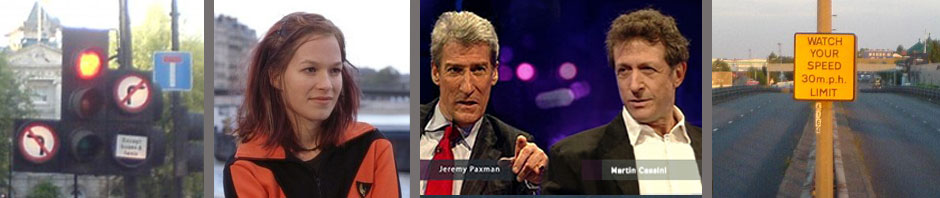
One Flew over the Traffic Light will feature a colourful range of road-users, from cab drivers to celebrities. On board if required are double Oscar winner, Jeremy Irons, and an Oscar-winning co-producer.
£50,000 will get the show on the road. The final budget is estimated at £1,500,000. Full funding buys the rights to 50% of net revenue (from film distribution and TV sales). Smaller stakes will be rewarded pro rata, e.g. £150,000 will qualify for 5% of net revenue, £15,000 for 0.5%.
For contributions of £3,750 or less, donors will qualify for a screen credit, an appearance in the film, an invitation to a special screening, and the satisfaction of supporting a life-enhancing cause. As far as possible, money raised will be seen on the screen, but third party introductions will qualify for an introducer’s fee.
Current (April 2020) tax incentives for investors:
- Under the EIS (Enterprise Investment Scheme), income tax relief at 30%. It can be taken in the tax year of investment or carried back to the previous tax year.
- Capital gains tax deferral of tax due on other capital gains for the life of the investment.
- For higher tax payers, loss relief which can be a deduction against income or a capital loss (thus a total tax relief up to 61.5% combined with initial income tax relief).
- Full inheritance tax relief provided the investment has been held for two years and is held at time of death.
Tangible returns can’t be guaranteed, but Super Size Me made $11,536,423 in the US, $1,995,967 in the UK, $2,016,222 in Australia, and $1,958,207 in Germany, to name just four territories. If One Flew over the Traffic Light gets similar distribution – and we’re all road-users, so it could be even bigger – it will see healthy returns. There is additional revenue potential from the international TV market.
Intangible benefits include involvement in a perception-shifting documentary feature that could bring universal, transformative gains.
To discuss sponsorship or support in cash and/or kind, please email martincassini at outlook dot com
Martin Cassini
